Self-Authorship: How to Take Control of Your Life
Self‑authorship is the ability to define your beliefs, identity, and direction on your terms — not by someone else's script. This guide shows you how to spot inherited rules, choose your own, and practise small, confident decisions that realign your life with what matters.
Take control of your life. Live on your own terms. Become the author of your life — that's self-authorship.
"If you are not living a self-authored life, then whose life are you living?"
— Inspirational Guidance
What Is Self‑Authorship?
Self‑authorship means you write the rules you live by. You examine expectations you have inherited from family, culture, and past versions of yourself — and you replace them with values and principles you actually believe in. Then you practise making choices that reflect them.
Psychologist Marcia Baxter Magolda, who studied adult development at Miami University over 25 years, found that self-authorship is the capacity to internally define your own beliefs, identity, and relationships — rather than having them shaped entirely by external authority. Her longitudinal research showed most people don't reach self-authorship until their late twenties or thirties, and many never make the transition fully.
- Name the script: Notice where "should" is steering your life.
- Choose your principles: Define 3–5 values and simple guardrails.
- Practise authorship: Make small, independent choices daily.
- Hold boundaries: Protect your energy, time, and attention.
- Iterate as you grow: Update the story when life changes.

Six Steps to Reclaim Your Life Narrative
Spot the Signs You're Living by Someone Else's Script
Identify patterns of people‑pleasing, autopilot choices, and chronic over‑explaining.
Read moreSurface Inherited Beliefs and Hidden Rules
Name the expectations you absorbed and decide which ones no longer fit.
Read moreDefine Your Values and Guiding Principles
Choose plain‑language principles and simple decision rules you will actually use.
Read morePractise Low‑Risk Independent Decisions
Build self‑trust by choosing for yourself in small, everyday situations.
Read moreRewrite the Parts of Your Story That Need Changing
Create updated narratives and boundary scripts that fit who you are now.
Read moreCreate Systems That Protect Your Authorship
Use routines, reviews, and boundaries to keep your story yours.
Read more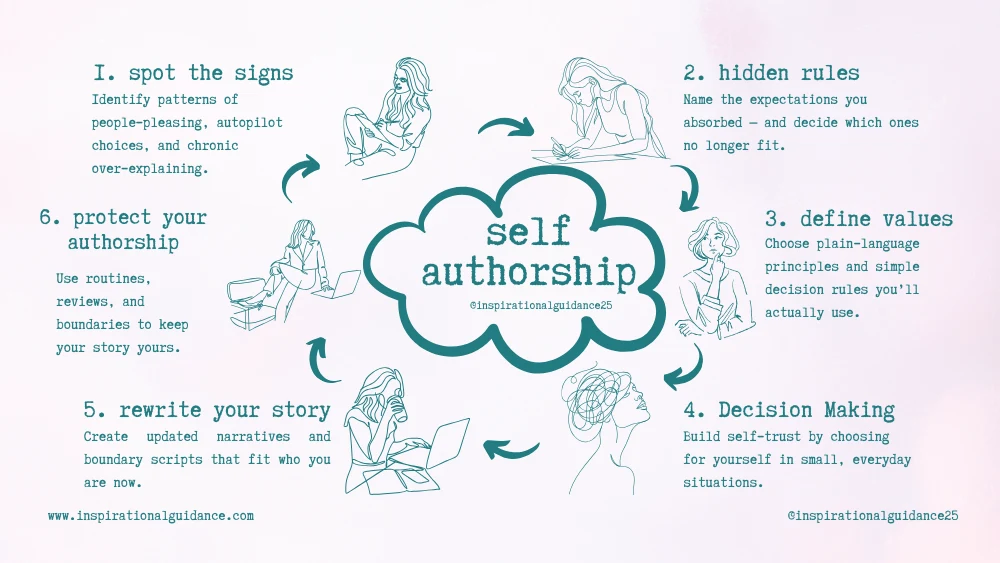
Signs You're Not in Control of Your Own Life
You over-explain simple decisions. You say yes before checking what you want. You feel persistent pressure to meet expectations that no longer fit who you are. These aren't personality quirks — they are signals that your choices are running on someone else's operating system.
The most common pattern we see is what we call automatic compliance: agreeing to things before your own preferences have had a chance to register. It shows up in conversations ("of course, that's fine"), in career choices ("I should stay in this job"), and in relationships ("they'd be upset if I said no"). The decision appears to be yours, but the mechanism driving it is external approval.
Other signs include: chronic over-explaining or justifying your choices to others; difficulty answering "what do you want?" without referencing what someone else wants; feeling guilty when you prioritise yourself; and a persistent gap between the life you live and the life you feel is yours. If several of these resonate, you are living further from your own authorship than you may realise.
Taking control starts with noticing — without judgement — where your choices are automatic rather than deliberate. Awareness is not the same as action, but it is the prerequisite for it. See the full guide to recognising the signs →
Identify the Rules You're Following
Every person carries an invisible rulebook — a set of beliefs about how they should behave, what they deserve, and what is possible for them. Most of these rules were written by other people: parents, teachers, peers, culture. You absorbed them before you were old enough to question them.
The exercise we use at Inspirational Guidance is a simple audit. Write down five statements that begin with "I should…" or "People like me don't…" or "It's not okay to…". Then ask: who decided that? When did you agree to it? Is it still true for who you are now? Most people find that several of their strongest behavioural rules trace back to a single person or a single formative experience — not to a principle they have consciously chosen.
Baxter Magolda described this stage as moving from following formulas to crossroads — the point at which external expectations begin to feel constraining rather than guiding. That friction is not a problem to solve; it is the beginning of authorship. The rules that create the most internal resistance are usually the ones most ready to be updated.
Once you have your list, highlight the rules that no longer reflect who you are. Write a replacement for each — one that you would choose today. Deeper guide to surfacing inherited beliefs →
Choose Your Own Standards
Guiding principles are the internal compass that replaces the external rulebook. Without them, you are always at risk of defaulting back to other people's standards — especially under pressure, when clarity is hardest to maintain.
Select 3–5 values in plain language. Not abstract ideals like "integrity" or "success" — but specific, personal statements: I choose depth over approval. I protect time for what matters most. I say what I mean, even when it is uncomfortable. These should feel slightly challenging to hold, because real values require real trade-offs.
For each principle, define one daily behaviour it requires and one decision filter it gives you. For example, if your principle is Autonomy, the daily behaviour might be making at least one unilateral decision each day without seeking permission, and the decision filter might be: "Does agreeing to this compromise my ability to manage my own time?" Clear standards make independent choices faster and more consistent, because you are not evaluating each situation from scratch.
Review your principles every quarter. They should evolve as you do. Full guide to defining your values →
Strengthen Your Decision-Making
Self-authorship is built in micro-decisions. The most effective place to start is not with a major life change — it is with the dozens of small choices you currently outsource without noticing.
What restaurant. What route to take. Whether to bring up that thing you've been sitting on. These feel trivial, but they are the practice ground where self-trust is built. Each time you make a low-stakes choice without seeking external validation, and then live with the outcome, you are adding to an internal evidence bank: I chose. It was fine. I can do this.
We recommend a 30-day decision journal. Each day, note one decision you made without asking for approval, and write one sentence on the outcome. After a month, most people are surprised by how consistently they made good calls — and how much mental energy they were spending seeking reassurance they didn't need.
Gradually move into higher-stakes territory: a work boundary, a relationship conversation, a creative risk. Confidence grows not from affirmation but from accumulated evidence. Practise independent decisions — step by step →
Rewrite the Direction of Your Life
Once you can see the old script clearly and have practised making deliberate choices, the next step is to rewrite the narrative — the story you tell about who you are and where you are going.
This is not about positive affirmations or wishful thinking. It is about identity statements that reflect choices you are already making. "I am someone who makes decisions based on my own priorities." "I do not need external permission to pursue what matters to me." These statements only land when they are grounded in real behaviour — which is why the decision-building phase comes first.
Boundary scripts are also part of rewriting. Instead of vague intentions to say no more often, write a specific script for the situations that most frequently pull you off course. "I'm not available for that, but thank you for thinking of me." Having the words ready removes the in-the-moment scramble that leads to automatic compliance.
Keep your identity statements visible — a note on your desk, a phone lock screen, a line in your journal header. Repetition reinforces ownership. How to rewrite your life narrative →
Protect the Life You're Building
Self-authorship is not a destination you arrive at; it is a practice you maintain. External pressures — other people's expectations, busy periods, setbacks — will regularly pull you towards old patterns. Systems are what hold your authorship in place when willpower and clarity are low.
The most effective single habit is a weekly review. Block 15–20 minutes on the same day each week and ask three questions: What choices this week aligned with my principles? Where did I default to an old pattern? What does next week need a clear "no" to? This is not a journalling exercise — it is a governance check. You are the author reviewing the week's draft.
Beyond the weekly review, build simple guardrails — specific, pre-committed rules that protect your most important resources. "No new commitments on weekday evenings." "I sleep on any decision that involves a significant time commitment." Guardrails remove the decision from the moment of pressure, where you are least likely to author well.
Audit your environment too. The people, inputs, and structures around you will either support or erode your authorship. This does not mean cutting everyone who challenges you — it means being deliberate about what you allow to shape your thinking. Build systems that protect your authorship →
Quick Answers About Taking Control of Your Life
What is self‑authorship?
Self‑authorship is the capacity to define your beliefs, identity, and life direction from an internal foundation — rather than by inherited expectations or the approval of others. The term originates in the work of developmental psychologist Marcia Baxter Magolda. Learn more →
What are the signs you're living by someone else's script?
Key signs include chronic over-explaining, saying yes before checking what you want, difficulty naming your own preferences, and a persistent gap between the life you live and the life that feels genuinely yours. Read the full guide →
How can I reclaim my life narrative?
Start by auditing the rules you live by — where did they come from and do you still agree with them? Replace inherited rules with values you have consciously chosen, then practise making decisions that reflect them. Step‑by‑step plan →
How can I build confidence in my own decisions?
Start with low‑risk decisions you normally outsource. Track outcomes in a brief daily note. Confidence grows from accumulated evidence that your own judgement is reliable — not from being told you are capable. Decision-building guide →
How do I stop letting others make my choices?
Write clear boundary scripts for the situations that most often pull you off course. Pre-committed language removes the in-the-moment scramble. Then practise holding the boundary even when it creates discomfort — that discomfort is the feeling of authorship, not a sign you are doing it wrong. Full guide →
What obstacles make self‑authorship harder?
The biggest obstacles are deeply habituated compliance patterns, fear of other people's disapproval, and the absence of clear internal standards to replace external ones. Without a defined value system, every decision reverts to seeking external guidance. Overcome them →
How can self‑authorship help during life transitions?
Transitions — career changes, relationship shifts, loss, relocation — remove the familiar structures that previously made your choices feel obvious. Self-authorship gives you an internal anchor: your own values and identity, not the external situation, become the thing you navigate from. Learn more →
What journal prompts support self‑authorship?
Try: "What rules do I live by and who wrote them?", "What would I choose if I knew no one would judge me?", "What story do I want to be able to tell about this period of my life in five years?" More prompts →
Featured Articles on Self‑Authorship
Reclaim Your Life Narrative: A Gentle Reset Back to Yourself
How to notice external scripts and re‑centre on your own values.
7 Signs You're Living by Someone Else's Script
Common patterns — and the first small shifts to change them.
Journal Prompts for Self‑Authorship
Reflective questions that help you write a story you believe in.
Free Download: Self‑Authorship Starter
A one‑page values‑to‑decisions sheet to begin reclaiming your life narrative.
FAQ
How is self‑authorship different from living with purpose?
Self‑authorship is the inner work of choosing your beliefs and rules — it is about who is writing your life. Living with purpose is using those beliefs to guide daily choices — it is about what you are writing towards. They reinforce each other: authorship without direction drifts; purpose without authorship is borrowed from someone else.
Do I need a big life change to practise self‑authorship?
No. The most effective starting point is the opposite — the smallest, lowest-stakes decisions you currently outsource. Self-authorship is built in daily micro-choices, not grand gestures. Start there, and it compounds.
What if people push back when I change?
Expect resistance — it is normal, and it does not mean you are doing it wrong. Have a short, calm boundary script ready and repeat it without escalating. Consistency is what teaches people how to treat you; explanations rarely are.
How do I keep self‑authorship going when life gets busy?
Use a weekly review (15 minutes, same day, three questions) and build simple pre-committed guardrails — e.g., "no new commitments after 6pm on weekdays". Systems protect your authorship precisely when willpower is depleted.
Is self-authorship a psychological concept?
Yes. Self-authorship is a well-established construct in adult developmental psychology, associated primarily with the research of Marcia Baxter Magolda, whose 25-year longitudinal study at Miami University tracked how adults develop the capacity to define their own beliefs, identities, and relationships. It is also referenced in the work of Robert Kegan, who describes self-authorship as a stage in the evolution of the "self-authoring mind".

Sources & Further Reading
- Baxter Magolda, M. B. (2001). Making Their Own Way: Narratives for Transforming Higher Education to Promote Self-Development. Stylus Publishing.
- Kegan, R. (1994). In Over Our Heads: The Mental Demands of Modern Life. Harvard University Press.
- American Psychological Association — Personality & Self
- Positive Psychology — Self-Authorship overview
Related Pillars
Live With Purpose
Use your values to guide daily choices.
Build Self‑Confidence
Action builds self‑trust — one step at a time.
Empowered Living
Boundaries and clear decisions protect what matters.
Emotional Resilience (PAUSE)
Use PAUSE to steady yourself and rebuild quicker after setbacks.
Journaling
Use journal writing for purpose and resilience. Turn insights into action.
Personal Growth Resources
Free personal development tools to continue your personal growth.
Reflection
Choose one inherited rule you are ready to retire. Write the replacement you will live by this week, and name the smallest action that proves it.