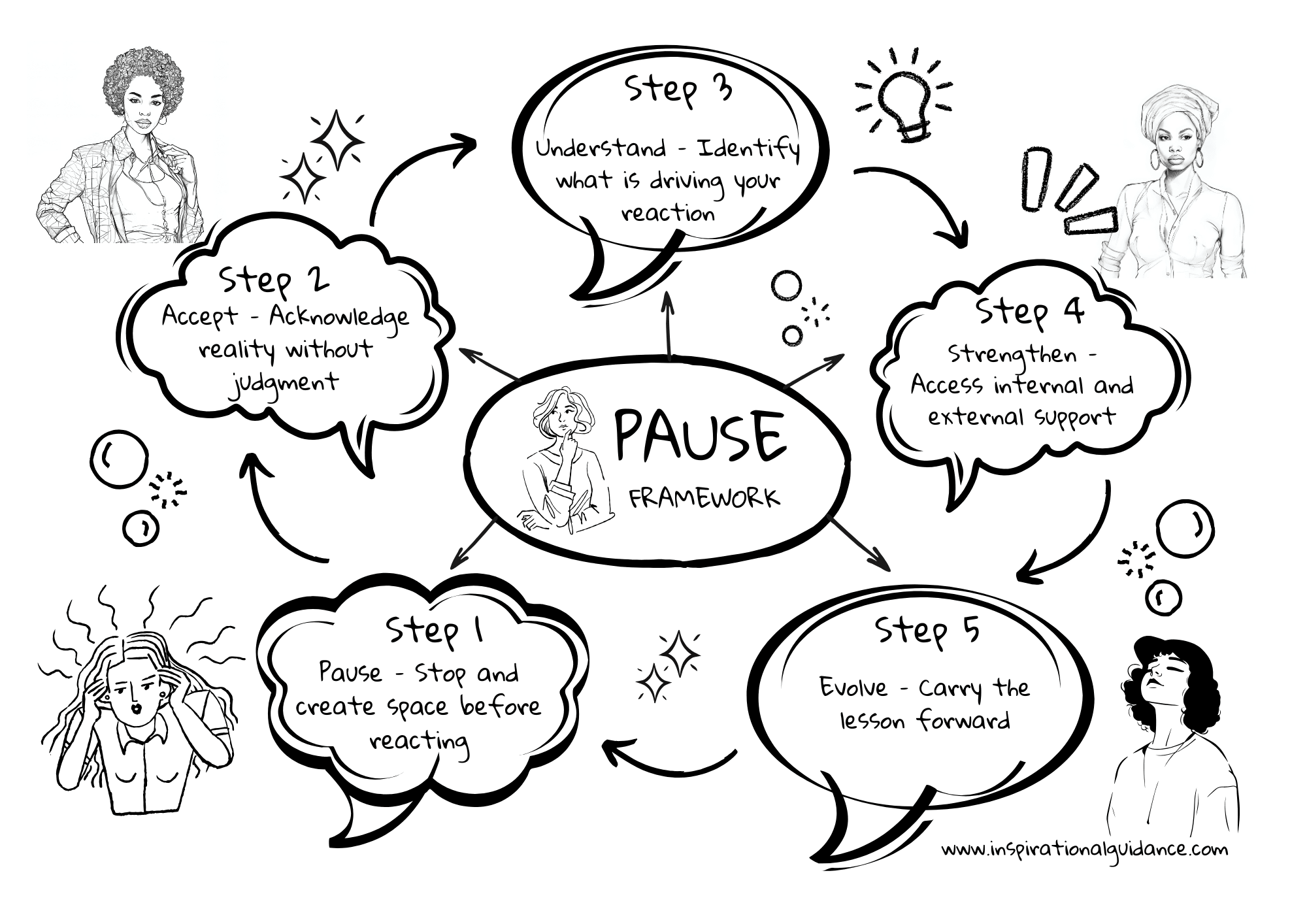
When emotions run high, it is tempting to deal only with the surface: what was said, what was done. But the U in PAUSE, Understand, is about digging deeper. It’s where you ask, “What’s really going on here?”
By the time you reach this step, you have already paused the knee-jerk reaction and accepted the reality of what is happening. Now comes the part that shifts you from surface-level coping to deeper resilience: self-awareness. Self-awareness is the ability to see what is driving your emotions and actions in a given moment without blame. It is looking beneath the surface to see why you feel what you feel and how those feelings are shaping your choices.
The reaction I've had to work hardest to understand in myself is the flash of irritation I get when someone cancels plans last minute. It took me a while to trace it back to years of being the reliable one who never got to cancel on anyone. Once I saw that, the irritation made a lot more sense, and it got a lot smaller.
I also remember a coaching conversation where someone was describing how angry she became every time her manager emailed her. She was convinced the problem was the emails themselves. As we talked, she suddenly stopped mid-sentence and said, “Actually... it's not the emails at all. It's that every one of them makes me feel as though I'm about to be told I've done something wrong.” That one insight completely changed the conversation. The emails had not changed but her awareness had.
- Understanding a reaction means asking what it is really about, not just what happened.
- Without it you may fix the wrong problem or repeat an old pattern.
- Curiosity beats self-criticism: the goal is to understand yourself, not to collect evidence against yourself.
- Even 30 seconds of curiosity can change your next move.
Why Understanding Matters
Resilience is not just about bouncing back. It is about moving forward with a better understanding of yourself. If you don’t understand the root of your reaction, you risk fixing the wrong problem, old patterns keep replaying, and you react based on past wounds, not present facts. Without this step, your actions may still be guided by old habits, past experiences, or unconscious patterns.
When you take time to understand:
- You address the cause, not just the symptoms. Your responses become calmer and more targeted.
- You reveal your triggers. You begin to notice which situations consistently provoke certain emotions.
- You connect past experiences with present reactions. Sometimes today’s situation is waking up yesterday’s feelings.
- You create new choices. Once you see the pattern, you are no longer trapped inside it.
- You strengthen self-trust. Every intentional response reminds you that you can handle difficult situations differently.
In many ways, self-awareness acts like a compass. Before you can decide where you want to go, you first need an honest understanding of where you are.
How to Build Understanding
- Ask a better questionSwap “Why is this happening to me?” for “What is this really about?” or “What exactly is making me react this way?” That shift moves your attention from blame to understanding.
- Check the timelineIs your reaction about this moment, or does it echo something from the past? Sometimes the present pokes an old bruise.
- Zoom outPicture yourself stepping back from the scene, like a director watching the action. Who else is involved, and what pressures are they under? What do you notice that you couldn’t see up close?
- Listen to your bodyYour body often notices stress before your mind catches up: shallow breathing, a clenched jaw, a knot in your stomach. These are often your first clue that something deeper is happening.
- Create a curiosity anchorIn NLP, curiosity is a powerful state. Lightly touching your chin or tilting your head can become a signal to stop judging and start exploring. Repeated often enough, it becomes a mental switch from reaction to reflection.
- Write it downJournaling reveals patterns we cannot see while everything is spinning around in our heads. Ask: What happened? How did I feel? What thoughts followed? Has this feeling shown up before?
Everyday Examples of Understanding in Action
- The interrupting colleague. A colleague interrupts you in a meeting and you feel a flash of irritation. Instead of snapping, you ask yourself: “Is this about them, or about me feeling overlooked?” You see you’ve been sensitive to this since a recent promotion you didn’t get. Now you can address the real source of tension.
- The sharp email. You see that your frustration is not really about the email. It reminds you of years spent feeling as though nothing you did was ever quite good enough.
- The family disagreement. You notice your instinct is to keep the peace, even when something matters to you. That habit made sense years ago, but perhaps it no longer serves you today.
- The skipped walks. You promised yourself evening walks but have skipped them three nights in a row. Instead of calling yourself lazy, you dig deeper and find you have been going to bed too late and feel too tired after work. You move your walks to weekend mornings, and suddenly the habit sticks.
- The missed plan. Instead of calling yourself undisciplined, you see that you agreed to far too much in the first place. The lesson is not to work harder. It is to plan more honestly.
I still catch myself doing this from time to time. If I miss something I planned to do, my first instinct is to wonder why I wasn't productive enough. More often than not, the real issue is that I expected one day to hold three days' worth of work. That is a planning problem, not a character flaw.
Why We Often Avoid Looking Deeper
Self-awareness can feel uncomfortable because it asks us to slow down long enough to notice what is really happening. Sometimes we avoid it because we worry about what we might discover. Sometimes we believe that understanding ourselves means being hard on ourselves. It does not. The purpose of self-awareness is not to collect evidence against yourself. It is to understand yourself well enough to make better choices next time.
“I don’t want to dig into this, it’ll be uncomfortable.”
Growth often starts in discomfort. You can choose to explore at your own pace.
“I don’t have time to work through everything.”
Understanding doesn’t require hours. Even 30 seconds of curiosity can change your next move.
Building the Habit
- Pause before trying to solve the problem.
- Ask yourself one honest question instead of ten anxious ones.
- Reflect on good experiences as well as difficult ones.
- Talk things through with someone you trust if conversation helps you process your thinking.
The Understand step sits at the heart of the PAUSE Framework for a reason. Once you understand what is really happening, you begin noticing old patterns before they take over, you stop reacting to situations that actually belong to your past, and you make decisions based on what is happening today instead of what happened years ago.
Try this today
- When I feel triggered today, what is this really about?Take one breath and ask. See if the answer surprises you.
- Has this feeling shown up before?
- Ask “What is underneath this reaction?” before trying to fix anything.
- Look at the timeline, zoom out, and listen to your body.
- Curiosity, not self-criticism, is what makes this step work.
This article is part of the PAUSE: Five Words That Can Change How You Handle Any Problem series. Download the free guide below to learn all five steps: Pause, Accept, Understand, Strengthen, and Evolve.